Scalar Operators
Convergence behavior for Interpolator, laplacian, gradient, partial, and mixed partials. Each operator section shows two h-refinement plots that together answer: 2. Which PHS order? — PHS3/5/7 all at poly_deg = 3. Holding the polynomial augmentation fixed isolates the effect of RBF smoothness alone; curves should be parallel on log-log (same asymptotic slope, different offsets).
- How much poly_deg? — polynomial degree sweep for each PHS order.
PHS1 is omitted from these plots: at poly_deg = 3 it would need data at a degree above its matched minimum, and its low kernel smoothness makes it uninteresting as a comparison point. See the matched-degree rule in the overview if you need guidance on the minimum poly_deg per PHS order.
IMQ and Gaussian h-refinement is covered on its own page (Shape-Parameter Bases) — their behavior is dominated by the interaction between ε and the stencil spacing, which deserves a single focused discussion rather than a repeated subsection per operator.
See the index for notation and methodology.
Interpolation
Interpolator performs global RBF interpolation (all points enter every weight). Expected convergence for polynomial augmentation degree m is O(h^{m+1}).
Which PHS order?
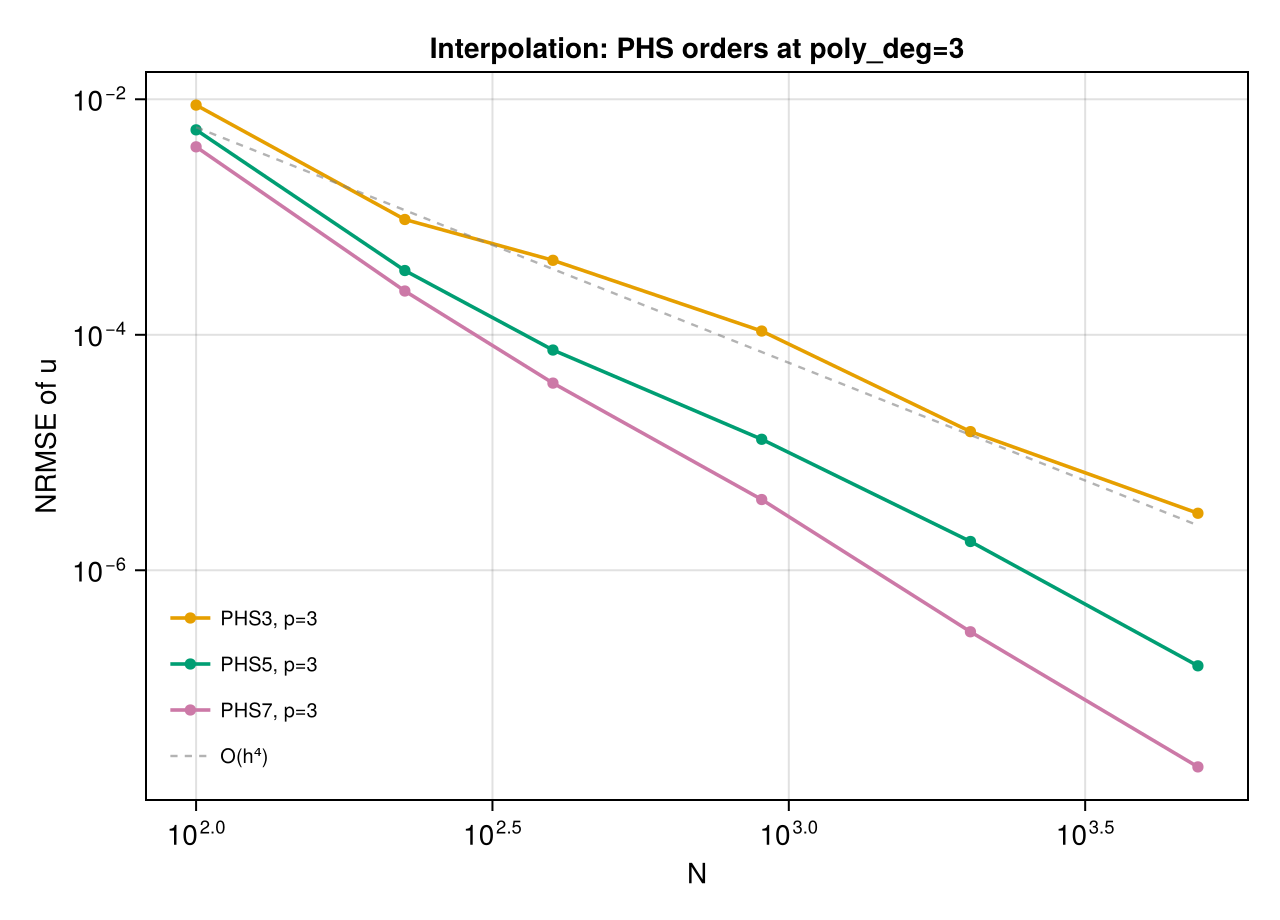
All three curves run parallel at the expected O(h⁴) slope. The only difference is the constant (vertical offset): PHS7 sits lowest, PHS5 in the middle, PHS3 on top. This is the clean signature — higher kernel smoothness does not change the rate but pays a smaller constant.
How much polynomial degree?
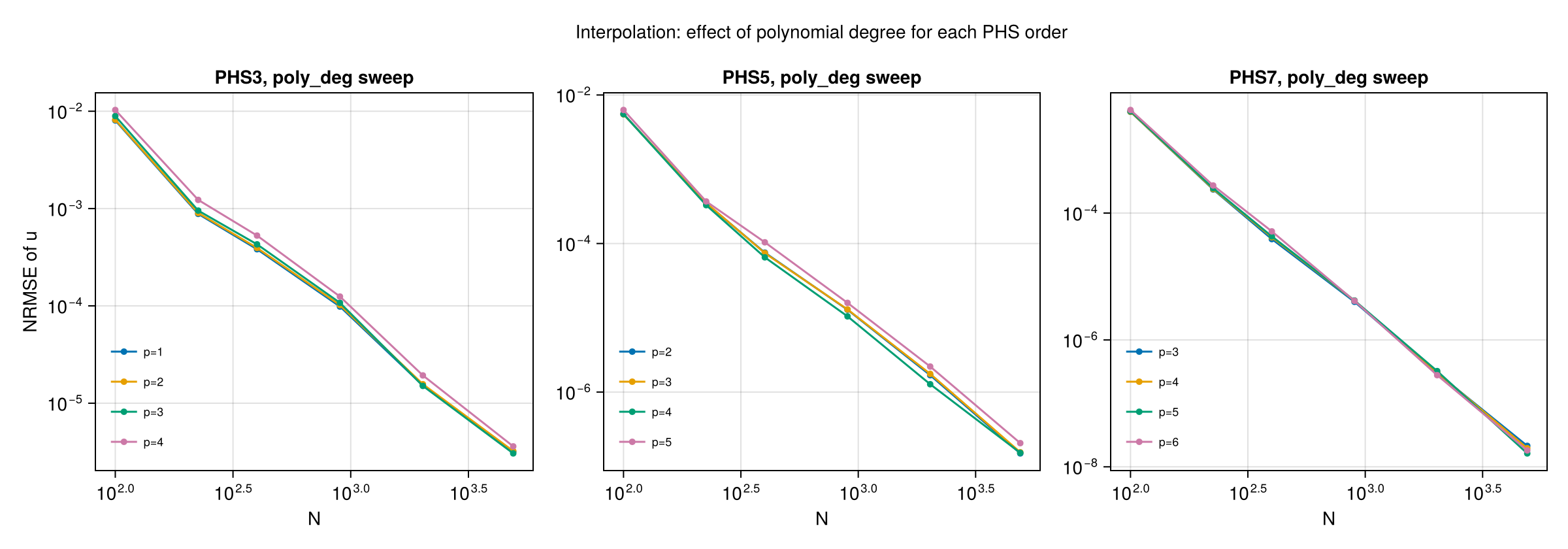
For each PHS order, adding more polynomial degree beyond the matched minimum generally helps — but with diminishing returns. PHS3 benefits from going up to p=4; PHS5 and PHS7 saturate around p=4–5 for this problem size.
Laplacian (∇²)
Expected rate for polynomial degree m: O(h^{m-1}) in 2D.
Excluded combinations
PHS1/p=1 and PHS3/p=1 are not plotted below because they do not converge for second derivatives. PHS1/p=1 is numerically pathological (errors near 10¹⁴); PHS3/p=1 plateaus near O(1) error regardless of N. Use poly_deg ≥ 2 and avoid PHS1 entirely for second derivatives. Shape-parameter bases have their own conditioning story — see Shape-Parameter Bases.
Which PHS order?
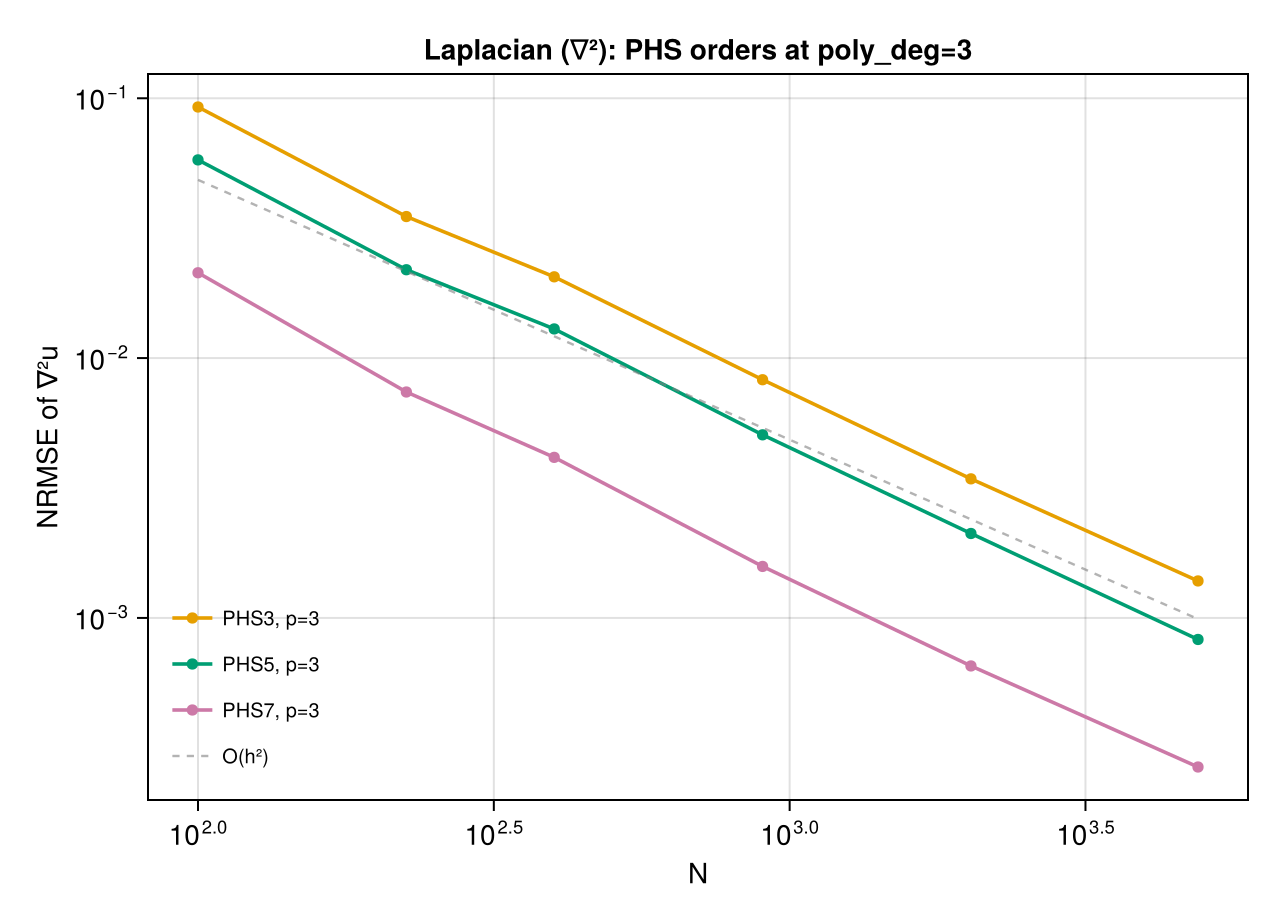
All three PHS orders converge at O(h²) — the poly_deg - 1 = 2 rate expected for a second derivative at poly_deg=3. Lines are approximately parallel; PHS7 has the smallest error constant, PHS3 the largest. The takeaway: once polynomial augmentation is held fixed, PHS order trades cost for a constant-factor reduction in error, not a better asymptotic rate.
How much polynomial degree?
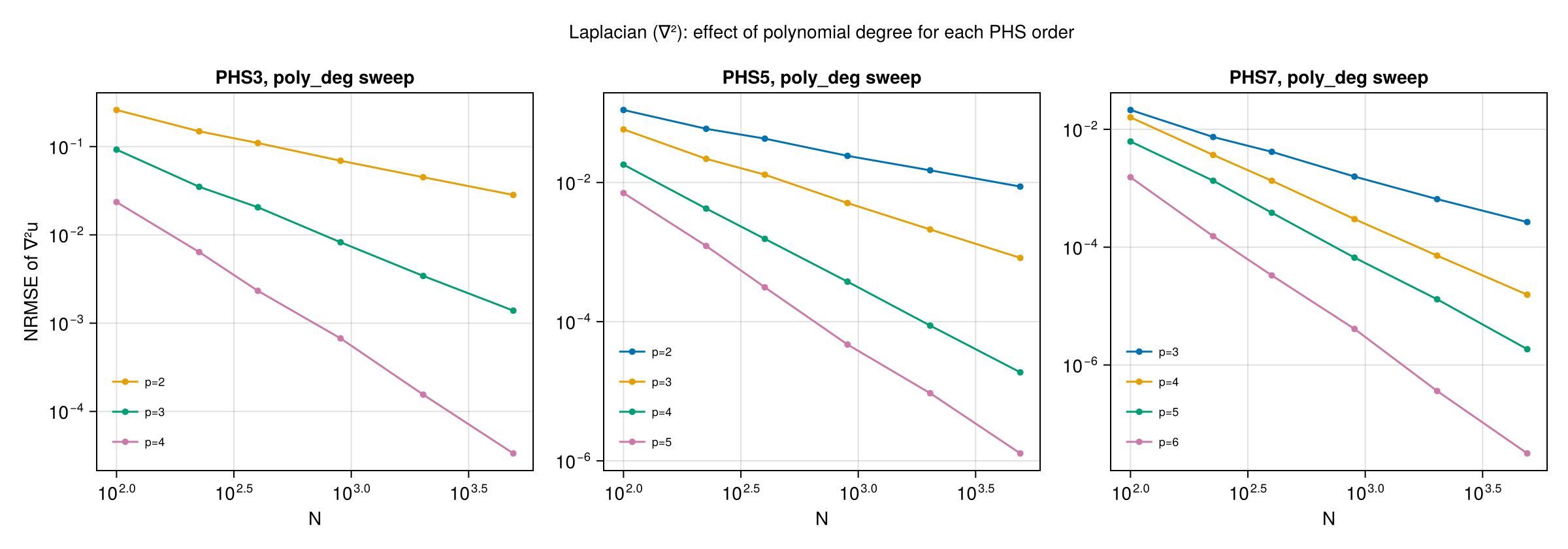
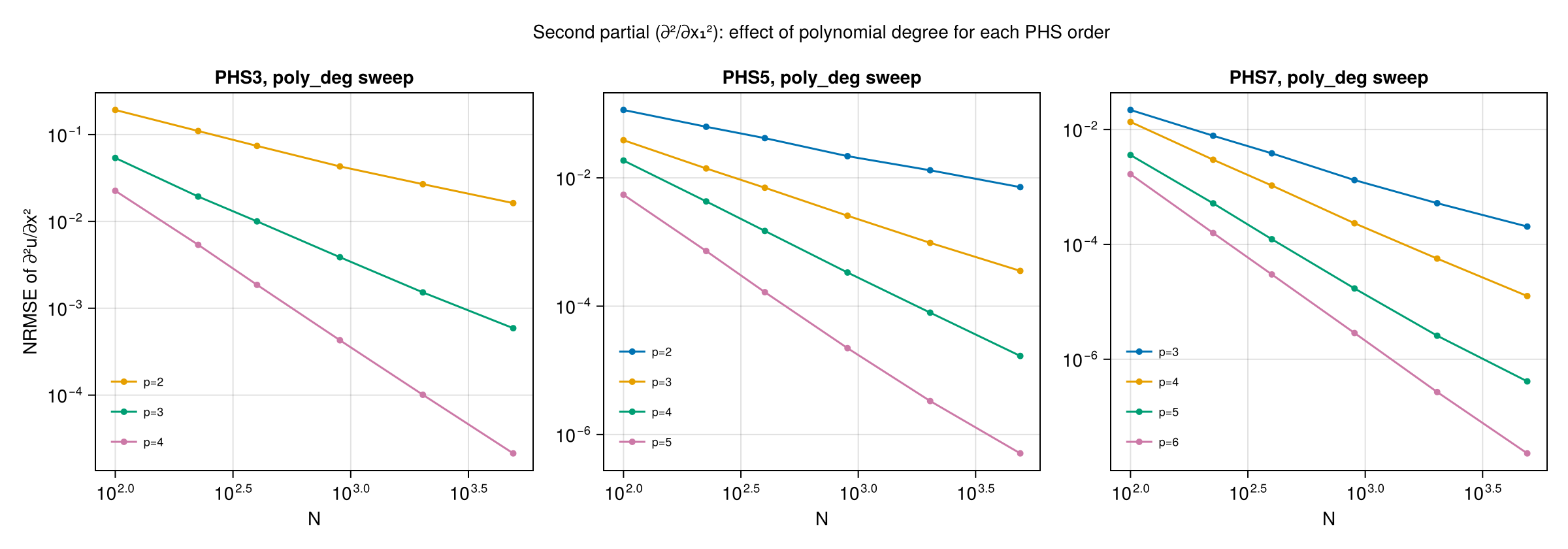
Increasing poly_deg by one typically adds two orders of convergence until the RBF smoothness caps the rate.
Gradient (∇)
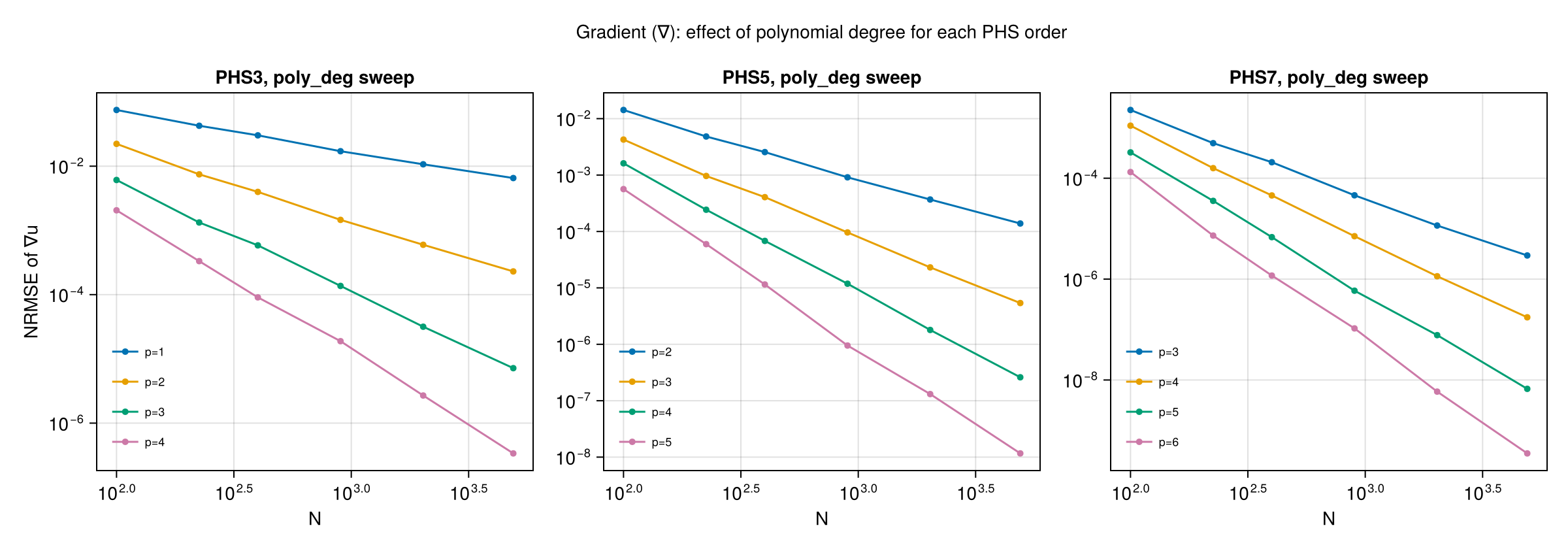
Expected rate for polynomial degree m: O(h^m) in 2D for each component.
Which PHS order?
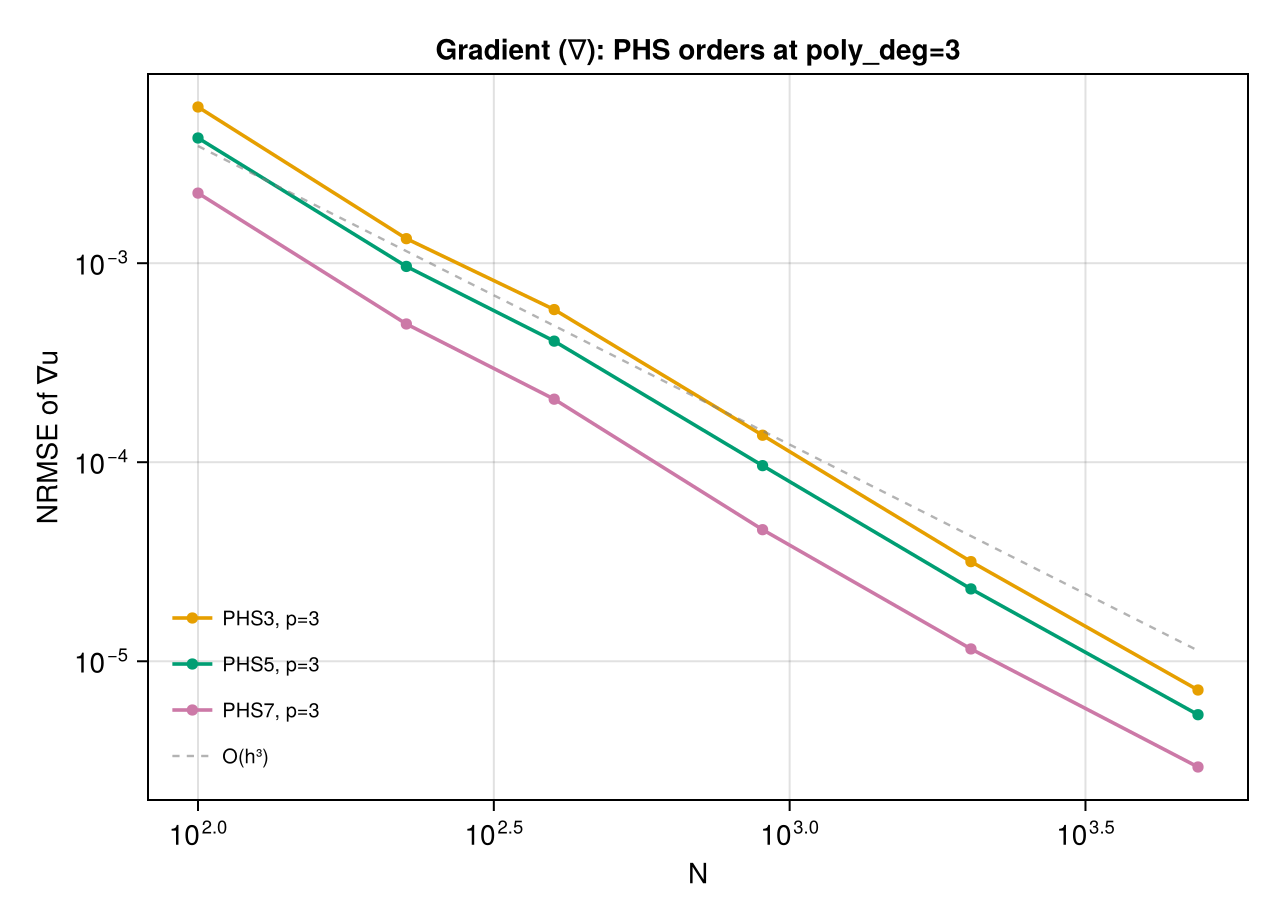
All three PHS orders follow the expected first-derivative rate O(h³) at poly_deg=3. Parallel lines; PHS7 has the smallest constant.
How much polynomial degree?
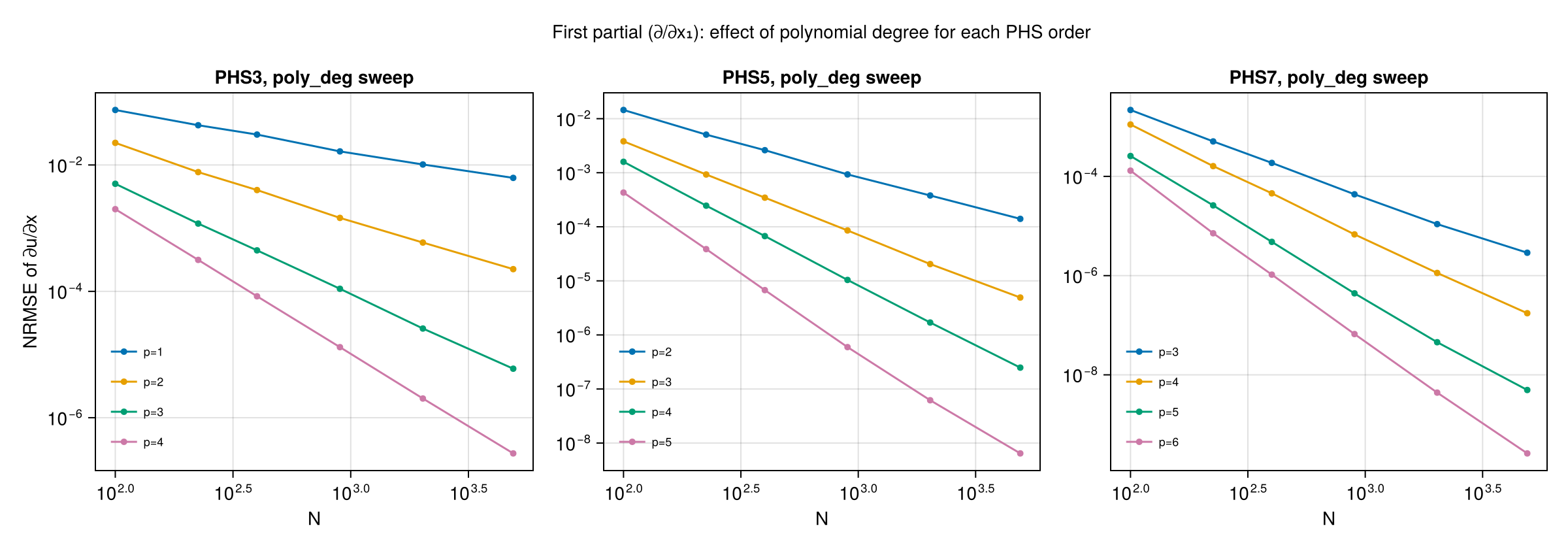
First partial (∂/∂xᵢ)
partial(pts, 1, 1) extracts a single gradient component. The convergence story matches the gradient exactly — which is reassuring, since internally it is a subset of the same stencil computation.
Which PHS order?
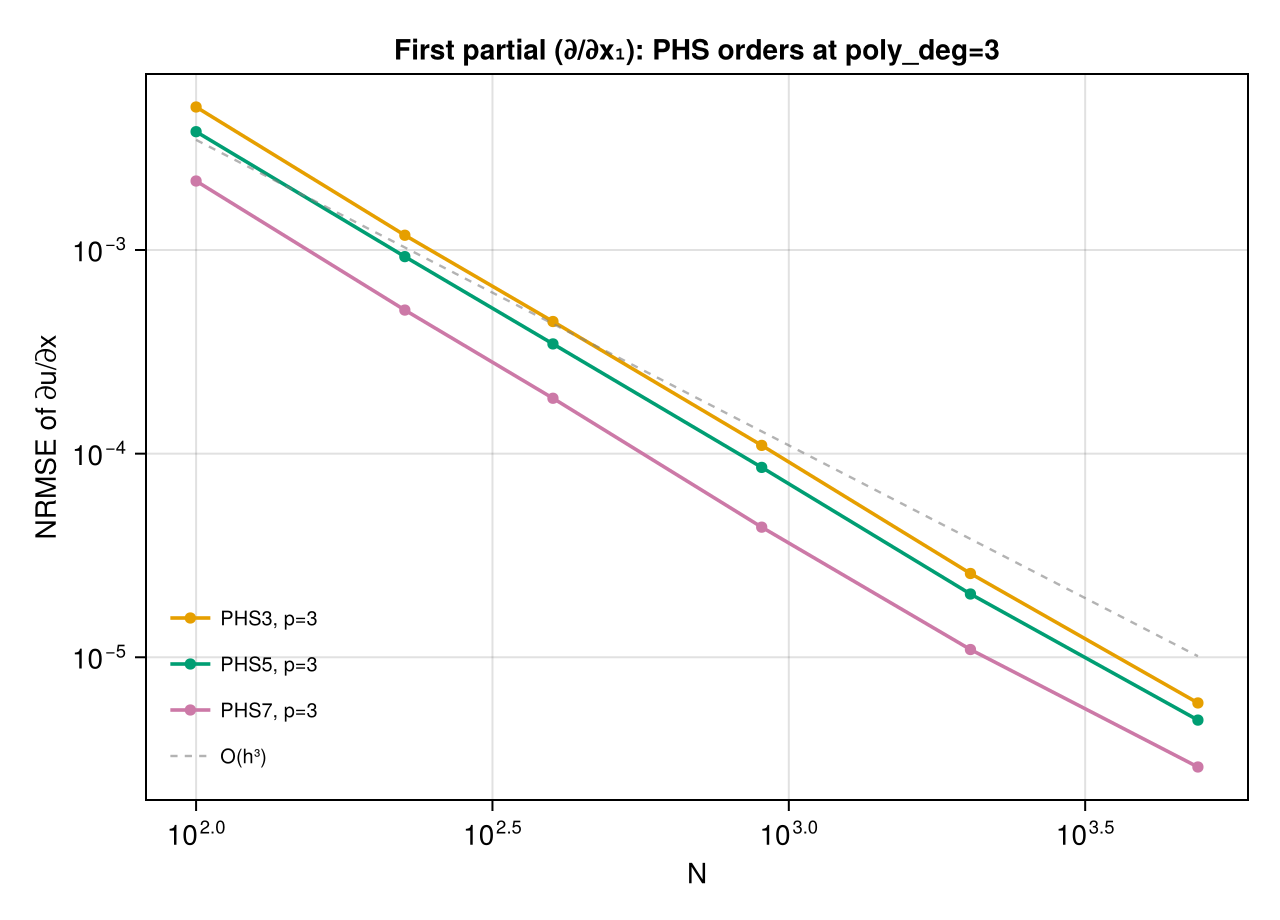
Parallel O(h³) convergence across PHS3/5/7, matching the gradient story.
How much polynomial degree?
Second partial (∂²/∂xᵢ²)
partial(pts, 2, 1) — a single second derivative. Same caveats as the Laplacian: PHS1/p=1 is unusable; PHS3/p=2 gives canonical O(h²).
Excluded combinations
Same set as Laplacian above: PHS1/p=1 and PHS3/p=1 are omitted for non-convergence.
Which PHS order?
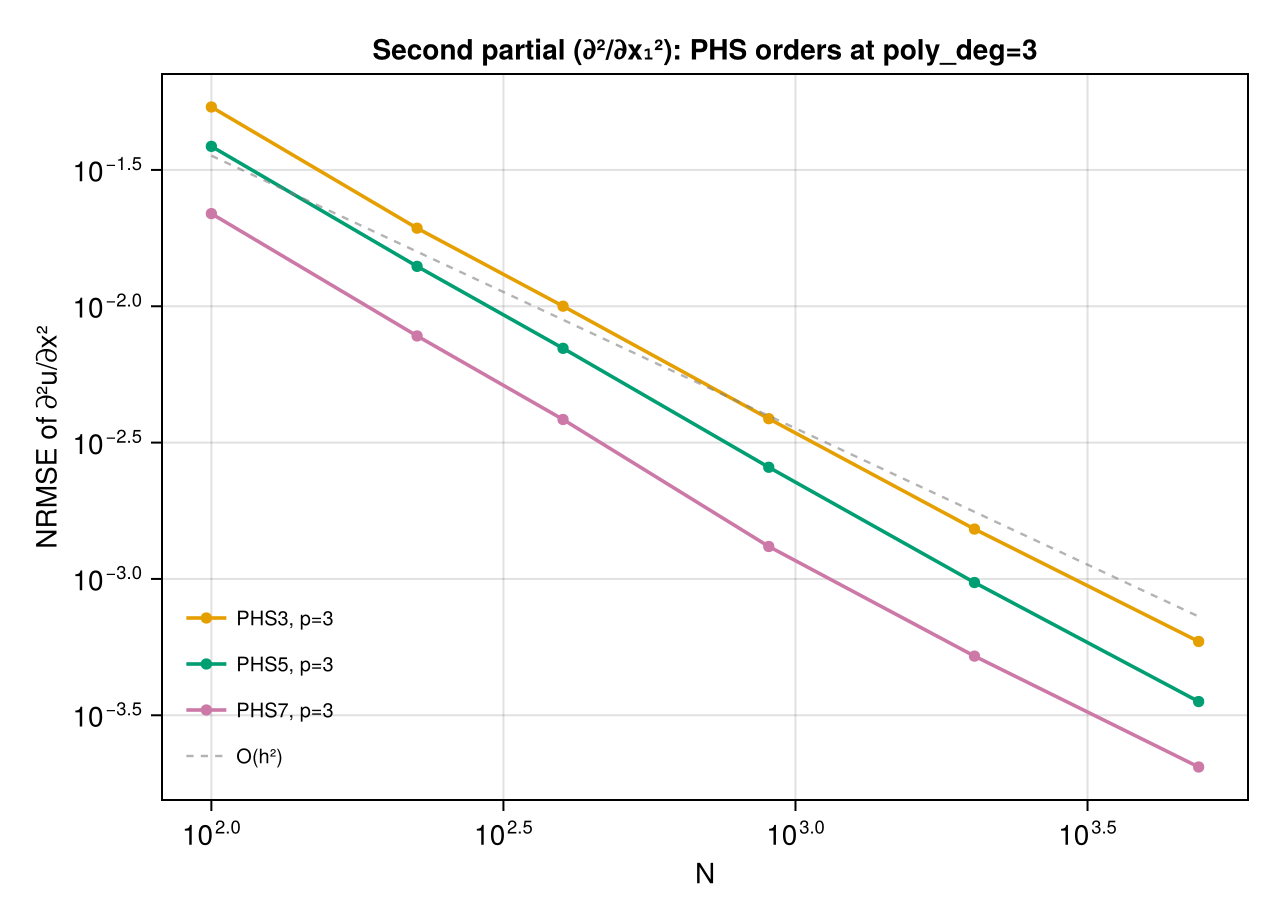
Parallel O(h²) convergence across PHS3/5/7 — same rate as the Laplacian.
How much polynomial degree?
Mixed partial (∂²/∂xᵢ∂xⱼ)
mixed_partial(pts, 1, 2) — a cross derivative. This operator is more demanding than the Laplacian: the Laplacian averages diagonal entries of the Hessian (which have radial symmetry under PHS), while mixed partials don't benefit from that symmetry.
Excluded combinations
A surprisingly long list of PHS combinations do not converge for mixed partials and are omitted from the plots below:
PHS1/p=1(error~3, no convergence)PHS3/p=1andPHS3/p=2(error~2and~10respectively, no convergence)PHS5/p=2(error~10, no convergence)
Minimum viable PHS configurations: PHS3/p=3 or PHS5/p=3. For IMQ and Gaussian, poly_deg ≥ 3 is required regardless of ε — see Shape-Parameter Bases.
Which PHS order?
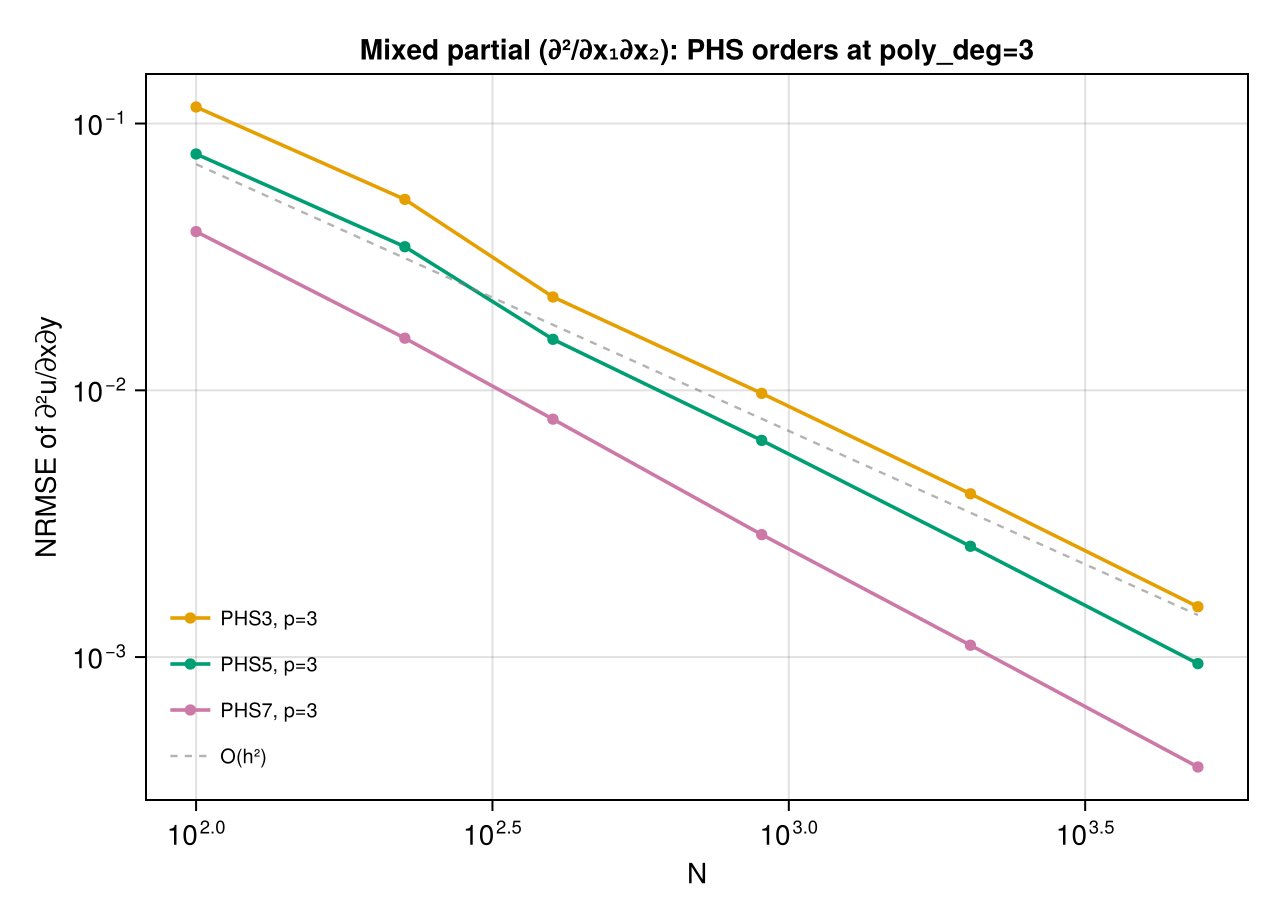
All three PHS orders at poly_deg = 3 converge cleanly at O(h²) — the mixed-partial non-convergence seen at lower polynomial degrees (see the warning above) is resolved here. PHS7 has the smallest error constant, as usual.
How much polynomial degree?
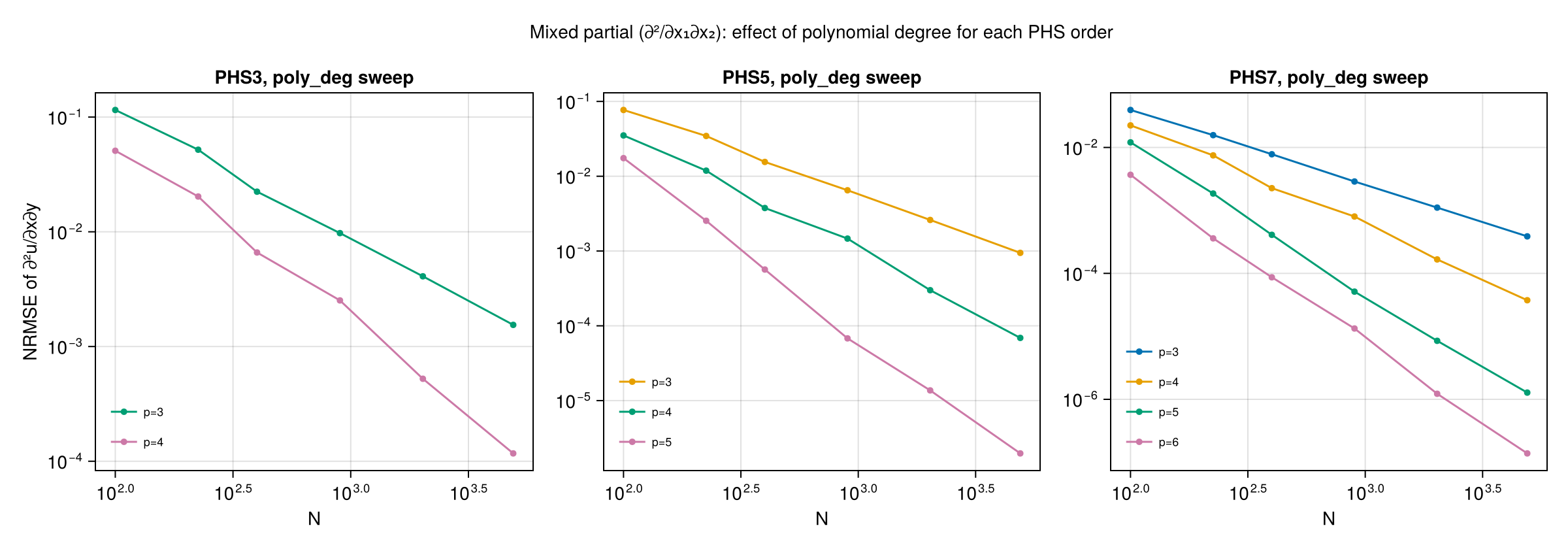
Raising PHS3 to p=3 is one path; PHS5/p=3 is the cleaner one.