RBF Neural Networks
Radial basis functions aren't just for meshfree PDE methods — they make excellent neural network activation functions. This page covers the theory behind RBF networks and walks through a hands-on comparison with a standard MLP using Lux.jl.
Why RBF Activations?
Local vs Global Activations
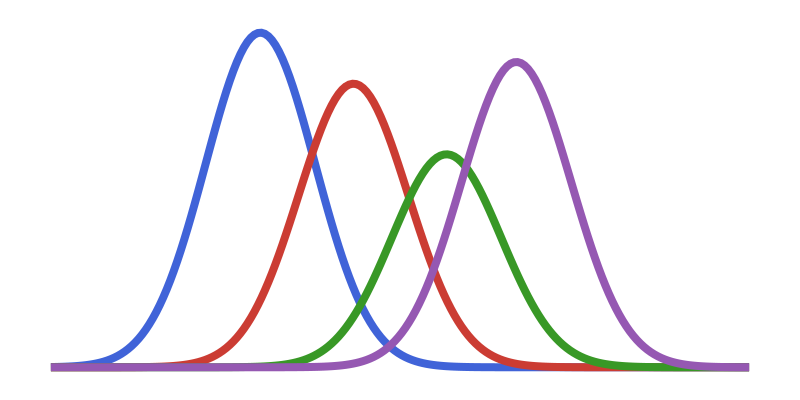
Standard activations like ReLU, tanh, and sigmoid are global: they partition the entire input space with hyperplanes, so every neuron responds to every input. Radial basis functions are local: each neuron is centered at a point in input space and responds most strongly to inputs near that center, decaying smoothly with distance.
This locality is particularly valuable for physics-informed neural networks (PINNs). Shouwei Li et al. (2024) introduced PIRBN (Physics-Informed Radial Basis Networks) and showed that PINNs naturally drift toward local approximation during training — RBF activations align with this tendency rather than fighting it, leading to faster convergence and better accuracy on PDEs.
The KAN–RBF Equivalence
Kolmogorov–Arnold Networks (KANs) attracted significant attention for placing learnable activation functions on edges rather than nodes. Li (2024) proved that KANs with RBF activations are mathematically equivalent to RBF networks, and that the simpler RBF formulation is faster in practice:
| Model | Test RMSE (function approx.) | Training time |
|---|---|---|
| Original KAN (B-spline) | Baseline | Baseline |
| FastKAN (Gaussian RBF) | Comparable | 3.3× faster |
| RBF-KAN (equivalence) | Comparable | Faster than KAN |
More recently, Putri et al. (2026) proved universal approximation for Free-RBF-KAN architectures with learnable centers, widths, and weights — confirming that RBF networks have the same expressive power as KANs without the implementation complexity.
Advantages for Scientific Computing
RBF activations inherit mathematical properties that standard activations lack:
| Property | RBF layer | Dense + ReLU/tanh |
|---|---|---|
| Smoothness | ||
| Locality | Each neuron covers a region | Every neuron responds globally |
| Interpolation guarantee | Exact with enough centers | No guarantee |
| Polynomial reproduction | Built-in via augmentation | Learned only |
| Known convergence rates | Yes (scattered data theory) | No |
| Interpretable parameters | Centers, shape params | Opaque weights |
Where RBF Layers Excel
RBF activations show the largest gains in scientific and geometric computing tasks:
| Application | Key result | Reference |
|---|---|---|
| PDE solving (PINNs) | 1000× better | RBF-PINN (Wang et al., 2024) |
| Physics-informed networks | Faster convergence on Poisson, Helmholtz, Burgers | PIRBN (Li et al., 2024) |
| Neural radiance fields | 10–100× fewer parameters for same quality | NeuRBF (Chen et al., 2023) |
| Neural fields (geometry) | Compact representation of SDFs and textures | NeuRBF (Chen et al., 2023) |
| Function approximation | Matches KAN accuracy, simpler architecture | FastKAN / RBF-KAN (Li, 2024) |
Learnable Shape Parameters
The shape parameter RBFLayer makes
Internally, the layer stores an unconstrained parameter
Initialization matters. Starting with init_shape=1.0 is a conservative choice; when the data has a known length scale, a value near the inverse of the typical center spacing trains faster and gives the plots below their locality.
Training an RBF Network
This section trains an RBF network and a standard MLP on the same 1-D regression problem so you can compare convergence, accuracy, and interpretability.
Setup
The target is a smooth background plus a narrow localized feature near
using RadialBasisFunctions
using Lux, Optimisers, DifferentiationInterface, Mooncake
using Random, Statistics
using CairoMakie

const RBFLayer = Base.get_extension(
    RadialBasisFunctions, :RadialBasisFunctionsLuxCoreExt
).RBFLayer

rng = Random.MersenneTwister(0)

f(x) = exp(-50f0 * (x - 0.3f0)^2) + 0.3f0 * sin(2π * x)

n_train = 60
x_train = collect(Float32, range(-1, 1; length=n_train))
y_train = f.(x_train)

x_plot = collect(Float32, range(-1, 1; length=400))
y_true = f.(x_plot)
Model Definitions
Both models use the same width so parameter counts are comparable. The RBF network starts its centers on a uniform grid inside the data domain (the default random initialization can land centers outside
num_centers = 20

init_centers_grid(rng, in_dims, num_centers) =
    reshape(collect(Float32, range(-1, 1; length=num_centers)), in_dims, num_centers)

rbf_model = Chain(RBFLayer(1, num_centers, 1;
    basis_type=Gaussian,
    init_centers=init_centers_grid,
    init_shape=3.0))

mlp_model = Chain(Dense(1 => num_centers, relu), Dense(num_centers => 1))

ps_rbf, st_rbf = Lux.setup(rng, rbf_model)
ps_mlp, st_mlp = Lux.setup(rng, mlp_model)

println("RBF parameters: ", Lux.parameterlength(rbf_model))
println("MLP parameters: ", Lux.parameterlength(mlp_model))
RBF parameters: 61
MLP parameters: 61Training
A shared training loop keeps things comparable. Both models are trained with Adam for 1000 epochs on MSE loss.
function train(model, ps, st; lr=0.01f0, epochs=1000)
    ps_flat, restructure = Optimisers.destructure(ps)
    opt_state = Optimisers.setup(Adam(lr), ps_flat)
    X = reshape(x_train, 1, :)
    Y = reshape(y_train, 1, :)
    backend = AutoMooncake(; config=nothing)
    loss_fn(p) = mean((first(model(X, restructure(p), st)) .- Y) .^ 2)
    losses = Float32[]
    for epoch in 1:epochs
        val, grads = DifferentiationInterface.value_and_gradient(loss_fn, backend, ps_flat)
        push!(losses, val)
        opt_state, ps_flat = Optimisers.update(opt_state, ps_flat, grads)
    end
    return restructure(ps_flat), losses
end

ps_rbf_trained, losses_rbf = train(rbf_model, ps_rbf, st_rbf)
ps_mlp_trained, losses_mlp = train(mlp_model, ps_mlp, st_mlp)

println("RBF  final MSE: ", round(losses_rbf[end]; sigdigits=3))
println("MLP  final MSE: ", round(losses_mlp[end]; sigdigits=3))
RBF final MSE: 3.33e-6
MLP final MSE: 0.0017Loss and Fit
Side-by-side: training loss on the left, the learned functions on the right. Watch the region around
X_plot = reshape(x_plot, 1, :)
y_rbf, _ = rbf_model(X_plot, ps_rbf_trained, st_rbf)
y_mlp, _ = mlp_model(X_plot, ps_mlp_trained, st_mlp)

colors = Makie.wong_colors()
fig = Figure(; size=(900, 360))

ax_loss = Makie.Axis(fig[1, 1];
    xlabel="Epoch", ylabel="MSE", yscale=log10, title="Training loss")
lines!(ax_loss, losses_rbf; color=colors[1], linewidth=2, label="RBF")
lines!(ax_loss, losses_mlp; color=colors[2], linewidth=2, linestyle=:dash, label="MLP")
axislegend(ax_loss; position=:rt, framevisible=false, labelsize=10)

ax_fit = Makie.Axis(fig[1, 2]; xlabel="x", ylabel="f(x)", title="Learned fits")
lines!(ax_fit, x_plot, y_true; color=:black, linewidth=2.2, label="Target")
lines!(ax_fit, x_plot, vec(y_rbf); color=colors[1], linewidth=2, label="RBF")
lines!(ax_fit, x_plot, vec(y_mlp); color=colors[2], linewidth=2, linestyle=:dash, label="MLP")
scatter!(ax_fit, x_train, y_train; color=(:gray, 0.55), markersize=7, label="Training data")
axislegend(ax_fit; position=:lt, framevisible=false, labelsize=10)

fig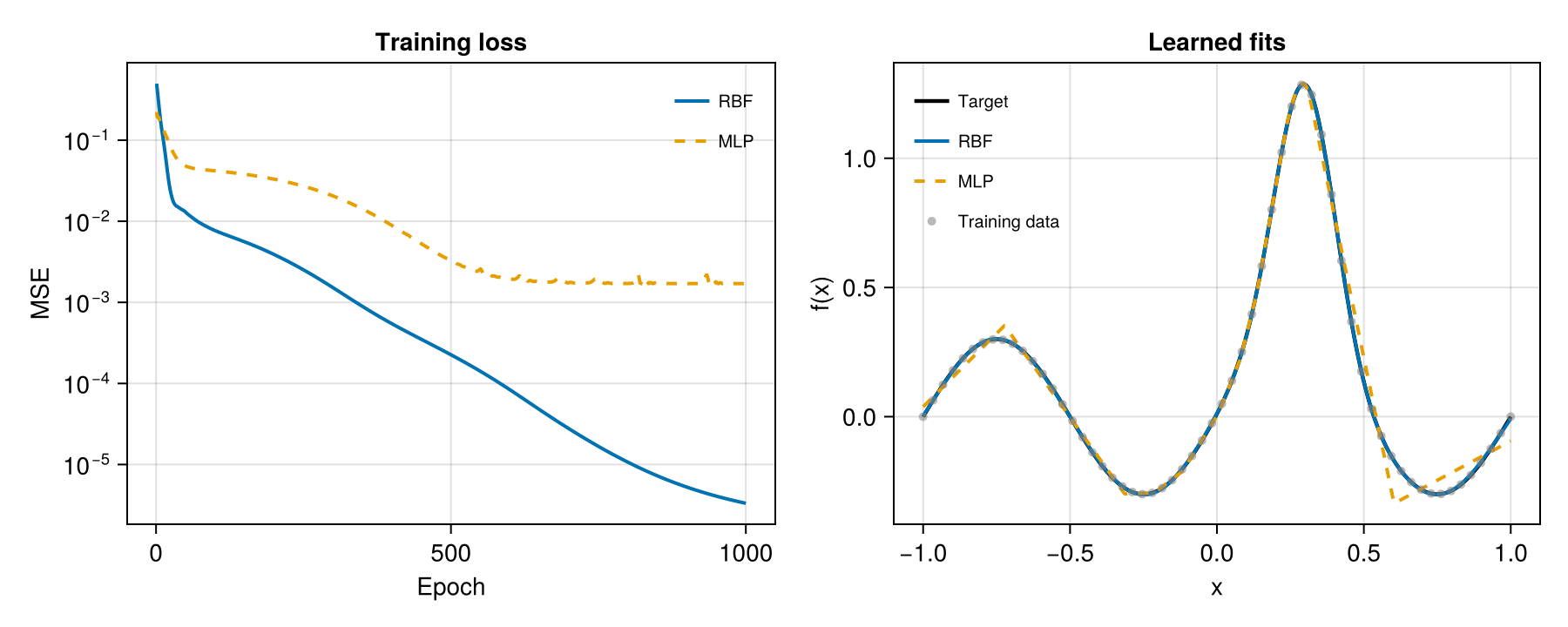
Basis Decomposition
The elegance of an RBF network is that it decomposes cleanly into its parts. Each neuron is a single Gaussian bump
centers = vec(ps_rbf_trained.layer_1.centers)
log_shape = ps_rbf_trained.layer_1.log_shape
epsilons = softplus.(log_shape)
weights = vec(ps_rbf_trained.layer_1.weight)
bias = ps_rbf_trained.layer_1.bias[1]

ε_range = (minimum(epsilons), maximum(epsilons))
cmap = :viridis

fig = Figure(; size=(900, 420))
ax = Makie.Axis(fig[1, 1]; xlabel="x", ylabel="wᵢ · φᵢ(x)",
    title="Each RBF neuron as a scaled Gaussian")

for i in eachindex(centers)
    phi = @. weights[i] * exp(-epsilons[i]^2 * (x_plot - centers[i])^2)
    lines!(ax, x_plot, phi;
        color=epsilons[i], colormap=cmap, colorrange=ε_range, linewidth=1.3)
end

network_out = sum(
    weights[i] .* exp.(-epsilons[i]^2 .* (x_plot .- centers[i]).^2)
    for i in eachindex(centers)
) .+ bias
lines!(ax, x_plot, network_out; color=:black, linewidth=2, linestyle=:dash,
    label="Σ wᵢφᵢ + b")
lines!(ax, x_plot, y_true; color=(:black, 0.35), linewidth=1.5, label="Target")
axislegend(ax; position=:lt, framevisible=false, labelsize=10)

Colorbar(fig[1, 2]; colormap=cmap, limits=ε_range, label="learned ε", width=14)
fig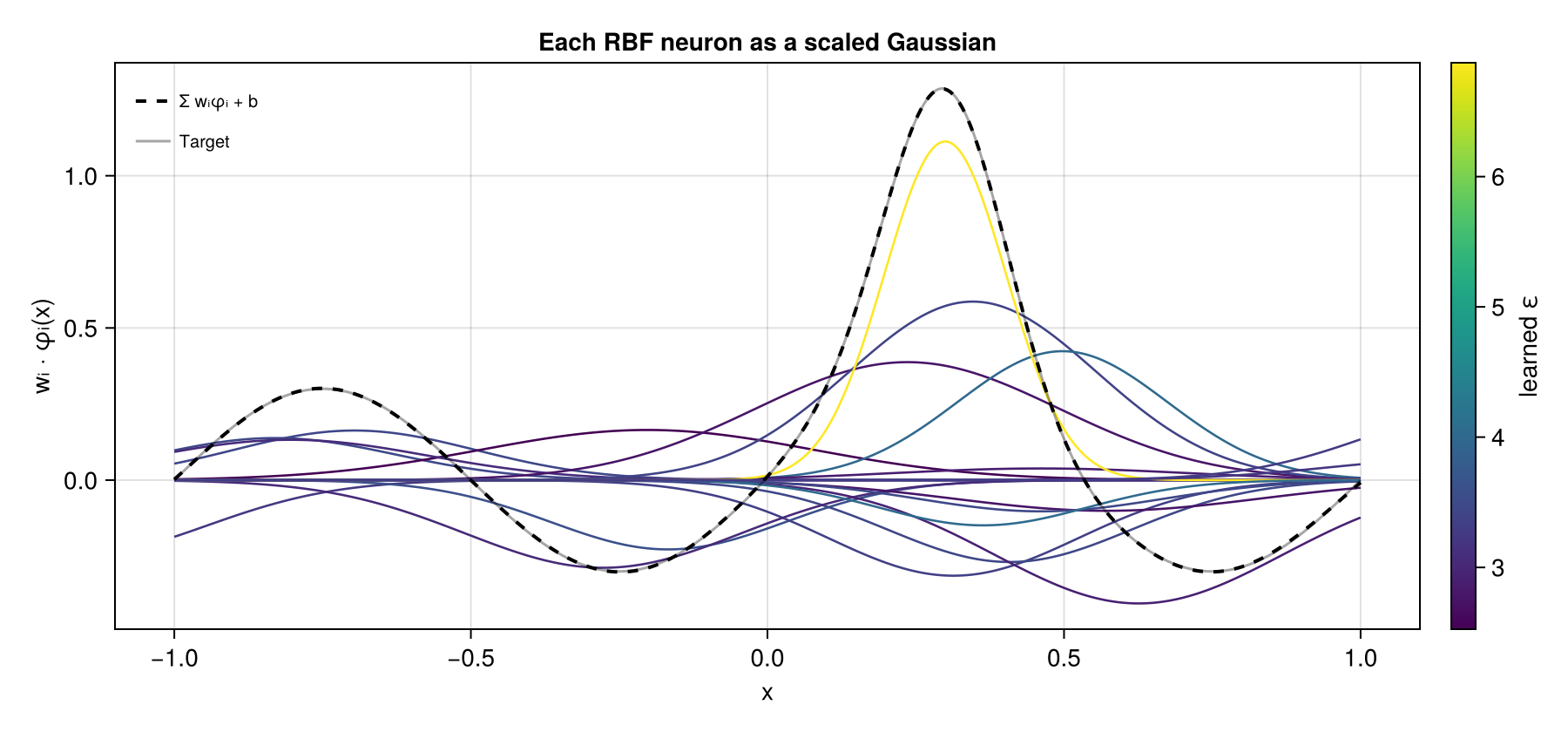
Centers with larger
When to Use Standard Activations Instead
RBF layers are not universally superior. Prefer standard Dense + activation when:
High-dimensional, non-spatial inputs — Euclidean distance becomes less meaningful beyond ~10–20 dimensions (curse of dimensionality). Tabular data with mixed categorical/numerical features is better served by ReLU networks.
Deep architectures — Stacking many RBF layers is less studied than deep ReLU/transformer networks. For tasks requiring depth (NLP, large-scale vision), standard architectures have more mature tooling and theory.
Massive scale — When training on millions of samples with thousands of features, the per-neuron distance computation in RBF layers adds overhead compared to a simple matrix multiply + pointwise activation.
No geometric structure — If inputs have no notion of "closeness" (e.g., one-hot encoded categories, graph node IDs), locality provides no benefit.
References
S. Li, Y. Liu, & L. Liu, "PIRBN: Physics-Informed Radial Basis Networks," arXiv:2404.01445, 2024. Link
Z. Li, "Kolmogorov–Arnold Networks are Radial Basis Function Networks," arXiv:2405.06721, 2024. Link
J. Zhu, "FastKAN: Very Fast Kolmogorov-Arnold Networks," GitHub, 2024. Link
D. A. Putri, A. P. Tirtawardhana, & J. H. Yong, "Free-RBF-KAN," Engineering Applications of Artificial Intelligence, 2026. Link
Z. Wang, W. Xing, R. Kirby, & S. Zhe, "RBF-PINN: Non-Fourier Positional Embedding in Physics-Informed Neural Networks," arXiv:2402.08367, 2024. Link
Z. Chen, T. Li, Z. Ding, C. Wang, H. Bao, & Z. Chen, "NeuRBF: A Neural Fields Representation with Adaptive Radial Basis Functions," ICCV, 2023. Link