Node Repulsion
Why Repulsion Matters
Meshless PDE methods (RBF-FD, generalized finite differences) are sensitive to point distribution quality. Irregular spacing leads to poorly conditioned interpolation matrices and reduced accuracy. Node repulsion iteratively pushes points apart to achieve a more uniform distribution while respecting the domain boundary.
With the Orthtree algorithm's default Bridson placement, the generated cloud already satisfies the Poisson-disk criterion, so repulsion is optional polish rather than a required pass — the default ClippedSpacingForce is built to preserve (never re-pack) such a cloud.
Usage
There are two methods, selected by dispatch:
Volume-only (no octree)
cloud = repel(cloud, spacing; β=0.2, max_iters=1000)Only volume (interior) points move. Boundary points remain fixed. Any volume point pushed outside the domain is filtered out via isinside, so the total point count may decrease.
Boundary-aware (with TriangleOctree, 3D only)
octree = TriangleOctree(import_mesh("model.stl", u"m"); classify_leaves=true)
cloud = repel(cloud, spacing, octree; β=0.2, max_iters=1000)
All points (boundary and volume) participate in repulsion. Escaped points are projected back to the nearest mesh triangle, so no points are lost. The boundary is returned as a single unified surface named :boundary — use split_surface! to re-establish surface distinctions.
Convergence history
conv = Float64[]
cloud = repel(cloud, spacing; β=0.2, max_iters=1000, convergence=conv)
repel returns a new cloud with NoTopology since points have moved — call set_topology again after repulsion. Pass a Vector{Float64} via the convergence keyword to collect the convergence history.
Parameters
| Parameter | Default | Description |
|---|---|---|
force_model | ClippedSpacingForce(β) | Force law, any RepelForceModel subtype |
β | 0.2 | Repulsion softening — feeds the default force_model |
α | 0.05 × min(spacing) | Step size — distance points move per iteration |
k | 21 | Number of nearest neighbors used in repulsion stencil |
max_iters | 1000 | Maximum number of repulsion iterations |
tol | 1e-6 | Convergence tolerance on the force norm (the default force's residual plateaus above it — the quality stops below are the practical criteria) |
cv_target | 0 (off) | Stop once the d_NN/spacing CV reaches this quality (≈ 0.07 matches direct generation) |
stall_after | 50 | Stop after this many iterations without CV improvement (0 disables) |
kick_after | 0 (off) | Break balanced standoffs by kicking the frozen closest pair |
cull_ratio | 0 (off) | Post-relaxation near-duplicate safety net; warns whenever it removes anything |
deposit_ratio | 0 (off) | Octree method only: convert escaped volume points into boundary points (emergent surface sampling) |
rebuild_every | 1 | Iterations between k-NN graph rebuilds (larger = cheaper, staler) |
Force Models
The force law is abstracted through RepelForceModel so users can choose how points interact. All models take a softening parameter β and implement compute_force(model, u) where u = r / s is the ratio of neighbor distance to local target spacing.
ClippedSpacingForce — default
ClippedSpacingForce is repulsion-only with compact support. Any configuration whose pairwise distances all exceed u0·s is an exact equilibrium — the Poisson-disk property — so an already-good (blue-noise) cloud is preserved or improved rather than re-packed. This is the right default for polishing seeded clouds and for re-relaxation inside a shape-optimization loop.
InverseDistanceForce
InverseDistanceForce is purely repulsive and monotonically decreasing. This is the original Miotti (2023) formulation. The force has no root, so equilibrium is reached only through damping via α — the point configuration never stops moving on its own, which is why a tol threshold is needed.
SpacingEquilibriumForce
SpacingEquilibriumForce is zero at u = 1 (neighbor exactly at the target spacing), positive for u < 1 (push apart), negative for u > 1 (pull together). Caution: the attractive branch behaves like a cohesion force whose preferred bond length is unreachable at the prescribed density, so long relaxations slowly condense the cloud into clusters and voids (rising spacing CV and coordination). Prefer ClippedSpacingForce unless you specifically want gap-filling attraction.
cloud = repel(cloud, spacing, octree;
              force_model = SpacingEquilibriumForce(0.2),
              max_iters = 500)
StrongSpacingForce
StrongSpacingForce is like SpacingEquilibriumForce but with a configurable singularity strength γ (default 3): at small u the repulsive core scales as u^(-2γ) instead of u^(-4), strong enough to break balanced standoffs where neighbor forces cancel the weaker default core. γ = 2 recovers SpacingEquilibriumForce.
Tuning Guide
β(repulsion strength): Values in the range 0.1–0.5 work well for most problems. Smaller values give gentler repulsion (slower convergence, more stable). Larger values produce stronger forces (faster convergence, risk of oscillation).k(neighbor count): Should roughly match the stencil size your meshless solver will use. Too small and points only feel local pressure; too large and the computation slows without benefit.α(step size): The default (5% of minimum spacing) is conservative. Increase for faster convergence on well-behaved geometries; decrease if points escape the domain.max_iters: 1000 is usually sufficient. Check the convergence vector to see if more iterations are needed.
Algorithm Details
Each iteration: 2. Rebuild the k-nearest neighbor tree from the current positions (every rebuild_every iterations)
For each point, compute a force from its
kneighbors using the chosenRepelForceModel. See Force Models above for the available laws.Move each point by an adaptive step
α_i = clamp(1/|F_i|, α_min, α)scaled by the local spacing and capped at one spacing unitConstrain points to the domain:
Without octree: points pushed outside are reverted (and filtered at the end via
isinside)With octree: boundary points are re-projected onto the mesh; escaped volume points revert, or convert into boundary points when
deposit_ratio > 0
- Record the force norm
max_i(|F_i|·s_i)as the convergence metric, and check the stopping criteria:tolon the force norm,cv_target/stall_afteron the d_NN/spacing coefficient of variation
Convergence Monitoring
The convergence vector records the force norm max_i(|F_i|·s_i) at each iteration:
conv = Float64[]
cloud = repel(cloud, spacing; β=0.2, max_iters=500, convergence=conv)

println("Final force norm: ", conv[end])
println("Iterations used: ", length(conv))
For the default repulsion-only force, the residual of a saturated packing plateaus at a nonzero value rather than decaying to tol — that is expected, and it is why the quality-based stops are the practical criteria: stall_after (on by default) ends the run once the d_NN/spacing CV stops improving, and cv_targetstops at an explicit quality (≈ 0.07matches what direct generation delivers). A run that hitsmax_iters warns.
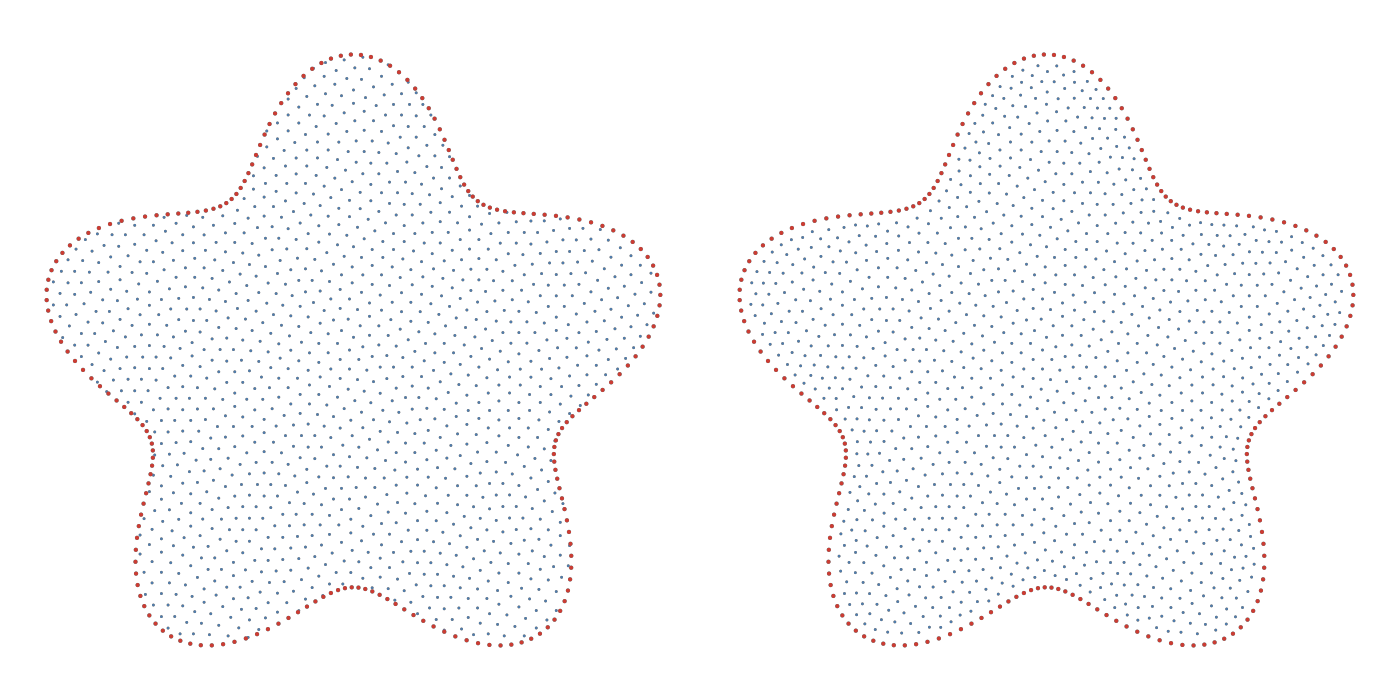
Left: raw discretization. Right: after node repulsion — the interior points (blue) relax into an even blue-noise distribution.
Verifying Distribution Quality
Use metrics to quantify the point distribution before and after repulsion:
# Before repulsion
metrics(cloud)

# After repulsion
cloud_repelled = repel(cloud, spacing)
metrics(cloud_repelled)
metrics prints the average, standard deviation, maximum, and minimum distances to each point's k nearest neighbors, plus the global separation (smallest nearest-neighbor distance), fill (largest), and their ratio — a mesh ratio near 1 means blue-noise-even. spacing_fidelity_metrics additionally measures d_NN/h(x) against the prescribed spacing (mean, CV, percentiles, coordination number).
Reference
- Miotti, M. (2023). Node repulsion for meshless discretizations.