Concepts
This page explains the core design decisions and type hierarchy behind WhatsThePoint.jl.
Type Hierarchy
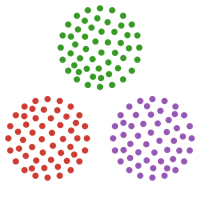
WhatsThePoint builds point clouds through composition:
PointSurface     — Points with normals and areas (one contiguous surface)
    ↓
PointBoundary    — Named collection of surfaces forming a closed boundary
    ↓
PointCloud       — Boundary + volume points + optional topology
All geometric types inherit from Domain{M,C} where M<:Manifold describes the geometric space (currently Euclidean: 𝔼{2} or 𝔼{3}) and C<:CRS is the coordinate reference system (Cartesian, Cylindrical, Polar, etc.). This parameterization comes from Meshes.jl and enables type stability and proper dispatch.
# A 3D point cloud in Cartesian coordinates on a Euclidean manifold;
# the third parameter is the topology type (NoTopology until set_topology):
PointCloud{𝔼{3}, Cartesian3D, NoTopology}
Surface Elements
Each boundary point is stored as a SurfaceElement containing:
point — The geometric position (a face center of the imported mesh — or a Poisson-disk sample when built with
PointBoundary(mesh, spacing))normal — Outward-pointing unit normal vector
area — Associated surface area
A PointSurface stores its elements as a StructArray{SurfaceElement}, giving column-oriented memory layout. This means iterating over all normals reads contiguous memory rather than striding through interleaved fields — a significant cache performance advantage when processing thousands of surface elements.
Immutability and Functional API
Most types in WhatsThePoint are immutable. Operations return new objects rather than mutating in place:
# set_topology returns a new cloud — the original is unchanged
cloud2 = set_topology(cloud, KNNTopology, 21)

# repel returns a new cloud (with NoTopology, since points moved)
cloud3 = repel(cloud2, spacing)
This design ensures compatibility with automatic differentiation frameworks and prevents stale state — if points move, the old topology object simply isn't used.
Exceptions — mutating operations (indicated by ! suffix):
split_surface!andcombine_surfaces!mutate aPointBoundary's internal surface dictionary. These reorganize existing surfaces without changing any point data.rebuild_topology!recomputes connectivity data in place for mutable topology types (KNNTopology,RadiusTopology), avoiding reallocation when only the spatial index needs refreshing.orient_normals!andupdate_normals!mutate normal vectors in place for efficiency, since normal arrays can be large and reorientation is a pure numerical update.
The pattern is: geometry creation and transformation (new point data) uses functional style; metadata reorganization and derived-quantity recomputation (normals, topology, surface labels) mutates in-place.
Topology
Topology represents point connectivity — the neighbor stencils used by meshless solvers.
Type hierarchy:
AbstractTopology— Abstract base with storage type parameterNoTopology— Singleton default (no connectivity computed)KNNTopology— k-nearest neighbor connectivityRadiusTopology— All neighbors within a fixed radius
Local vs global indices: Topology on a PointSurface or PointVolume uses local indices (1 through length(surf)). Topology on a PointCloud uses global indices (1 through length(cloud)), where boundary points come first, followed by volume points.
# Surface topology — local indices
surf = set_topology(surf, KNNTopology, 10)
neighbors(surf, 3)  # indices into surf, e.g. [1, 4, 7, ...]

# Cloud topology — global indices
cloud = set_topology(cloud, KNNTopology, 21)
neighbors(cloud, 3) # indices into cloud, e.g. [1, 2, 5, 102, ...]
Topology is computed eagerly when set_topology is called and is never automatically invalidated. Operations that move points (like repel) return objects with NoTopology — call set_topology again after repulsion.
Units
WhatsThePoint integrates with Unitful.jl. Physical units work directly throughout the API:
spacing = ConstantSpacing(1mm)
cloud = set_topology(cloud, RadiusTopology, 2mm)
split_surface!(boundary, 75°)
Units propagate through all operations — point coordinates, normals, areas, and spacing values all carry their units consistently.
Units enter the pipeline at import: mesh files carry no unit metadata, so every file-loading entry point (import_mesh, PointBoundary, import_surface, suggest_spacing) requires the unit the file's raw numbers are meant in, and reinterprets them in that unit (a stored 46 becomes 46 mm — no conversion).
Parallelism
WhatsThePoint uses OhMyThreads.jl for threaded execution. The following operations are parallelized:
Normal computation and orientation (
compute_normals,orient_normals!)Point-in-volume testing (
isinside)Node repulsion (
repel)Orthtree (octree/quadtree) queries and construction
To use multiple threads, start Julia with:
julia -t auto    # use all available cores
julia -t 8       # use 8 threads
No code changes are needed — parallel execution is automatic when threads are available.
Euclidean Assumption
WhatsThePoint currently supports Euclidean manifolds only (𝔼{2} and 𝔼{3}). Functions like compute_normals, orient_normals!, discretize, repel, and isinside have explicit Euclidean type constraints.
Any coordinate system (Cartesian, Cylindrical, Polar, etc.) is supported on a Euclidean manifold — the constraint is about geometric structure (flat space), not coordinate representation.
The type system is designed so that non-Euclidean geometries (spherical, hyperbolic) can be added in the future through new method dispatches with appropriate geodesic operations.